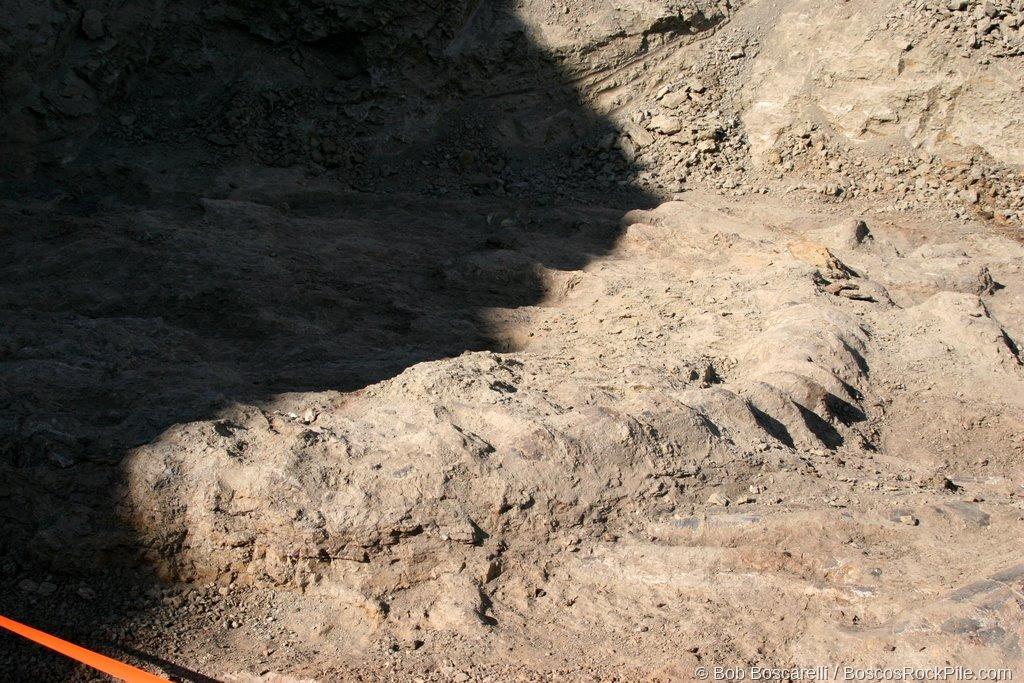
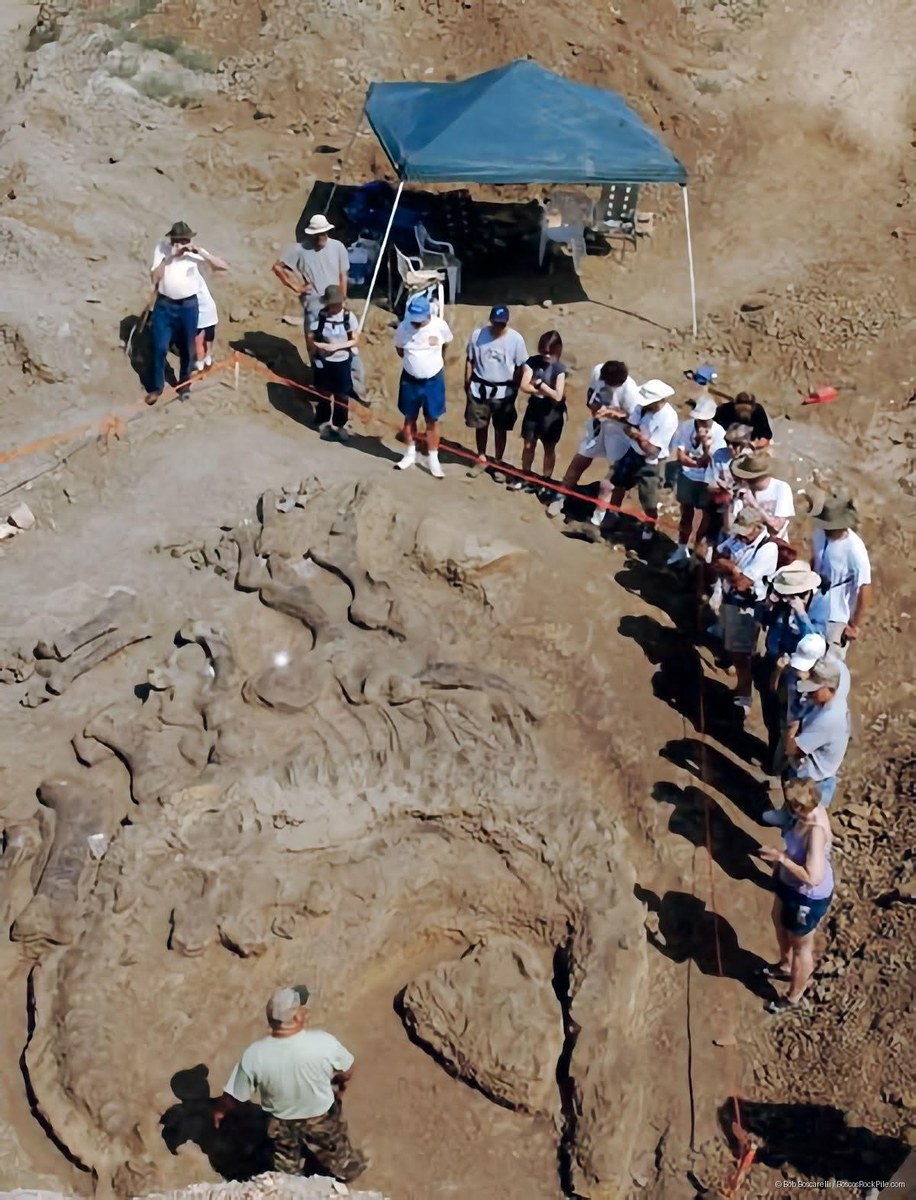
Camarasaurus sp. quarry overview Shell Wyoming 2007 with 20 visitors for scale
Camarasaurus sp. — the Shell Wyoming quarry during the 2007 season. Over 20 visitors stand around the exposed skeleton, illustrating the extraordinary scale of the specimen. Morrison Formation, Bighorn County, Wyoming. © Bob Boscarelli / BoscosRockPile.com

Camarasaurus Dig — Shell, Wyoming, 2007

In the summer of 2007, Bob Boscarelli led and documented a multi-week paleontological field expedition in Shell, Bighorn County, Wyoming — deep in the heart of the Morrison Formation. What followed was one of the most remarkable private fossil documentation projects in the region: week after week of excavation revealing articulated sauropod skeletons, massive limb bones, and an extraordinary concentration of Late Jurassic material spanning the entire excavation season from late June through early August.

The Morrison Formation at this location preserves a bone bed from approximately 155–145 million years ago, during the Late Jurassic period. The dominant taxon recovered was Camarasaurus sp. — the most common sauropod dinosaur of the Morrison Formation — along with associated elements consistent with Diplodocus sp. and indeterminate sauropod material. The site was also visited by paleontologist Paul Sereno, who examined specimens and advised the crew during one memorable dig day.

Location: Shell, Bighorn County, Wyoming  |  Formation: Morrison Formation  |  Age: Late Jurassic (~155–145 Ma)  |  Season: June–August 2007


Fossil Specimens

The following photographs document fossil specimens recovered or observed in situ at the Shell Wyoming excavation site. All images are © Bob Boscarelli / BoscosRockPile.com. High-resolution versions are available for research and publication licensing — see the contact section below.
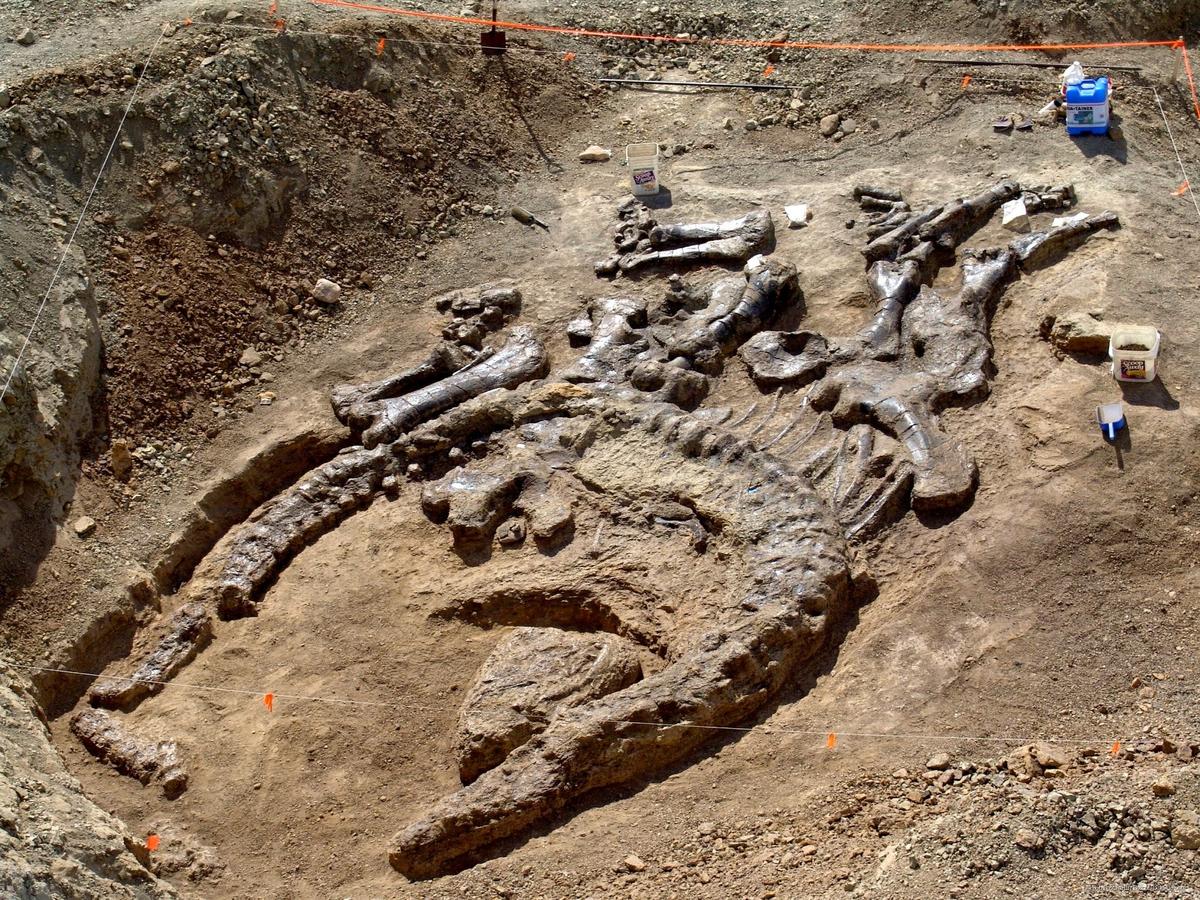
Diplodocus sp. articulated skeleton aerial view — Shell Wyoming Morrison Formation 2007
Diplodocus sp. — near-complete articulated sauropod skeleton, aerial view. Ribs, vertebral column, and limb elements visible across the full quarry floor in anatomical position. This level of articulation indicates rapid burial following death. Morrison Formation, Shell, Wyoming, 2007. © Bob Boscarelli / BoscosRockPile.com
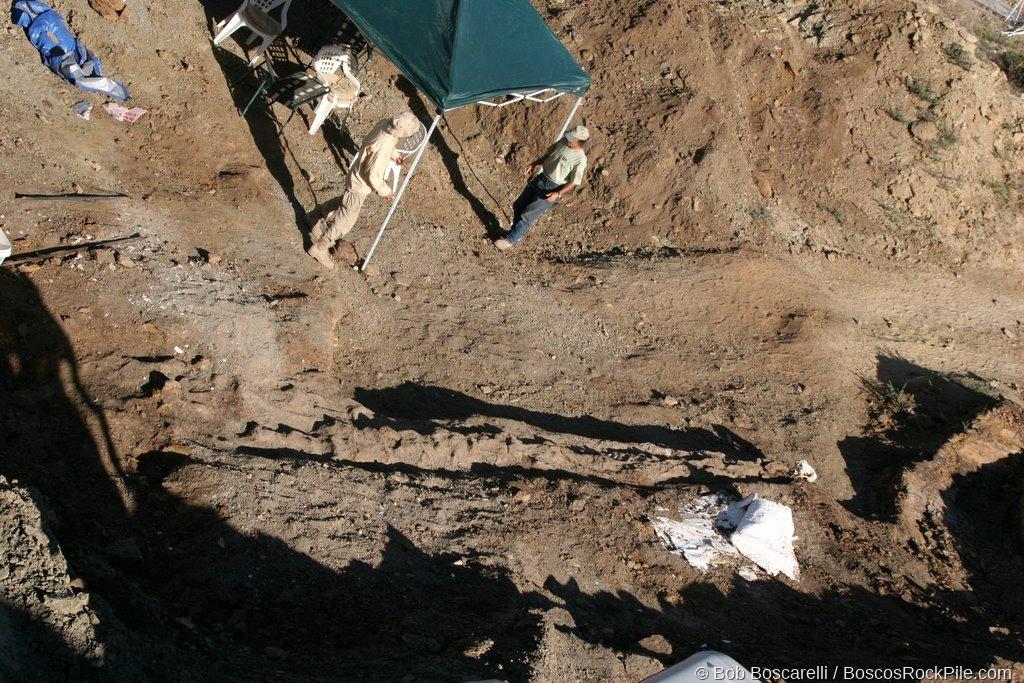
Articulated vertebral column full length
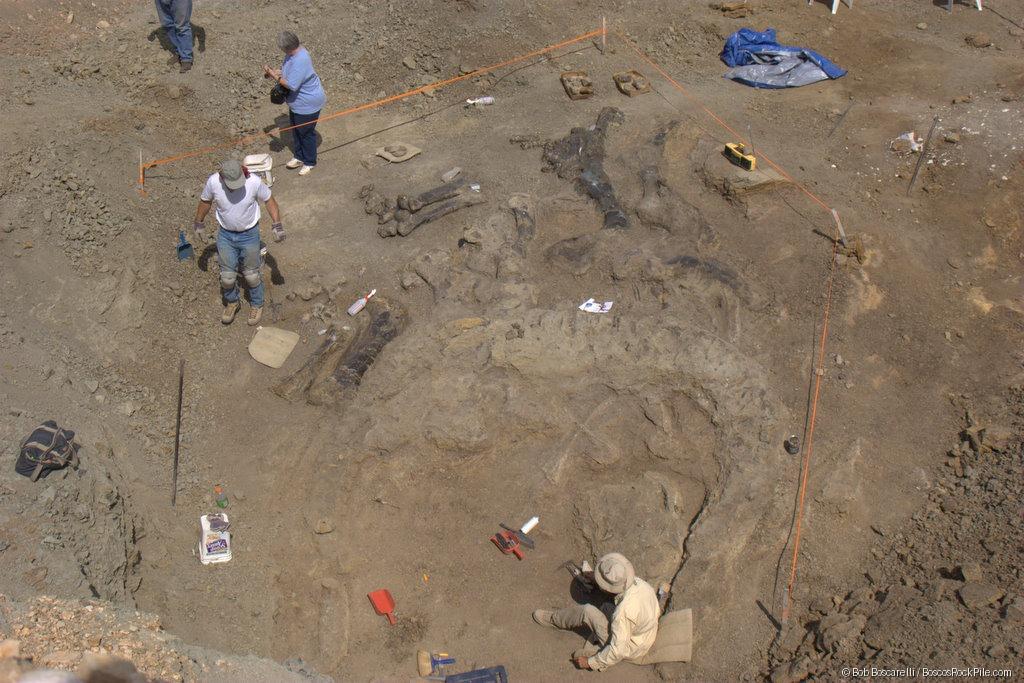
Articulated sauropod vertebral series running diagonally across the quarry floor — estimated 5+ meters in length. Field canopy and two diggers provide scale. June 23, 2007.
Sauropod dorsal vertebrae neural spines close-up
Museum-quality close-up of articulated dorsal vertebral series. Tall neural spines and blocky centra characteristic of a large Morrison Formation sauropod. June 23, 2007.
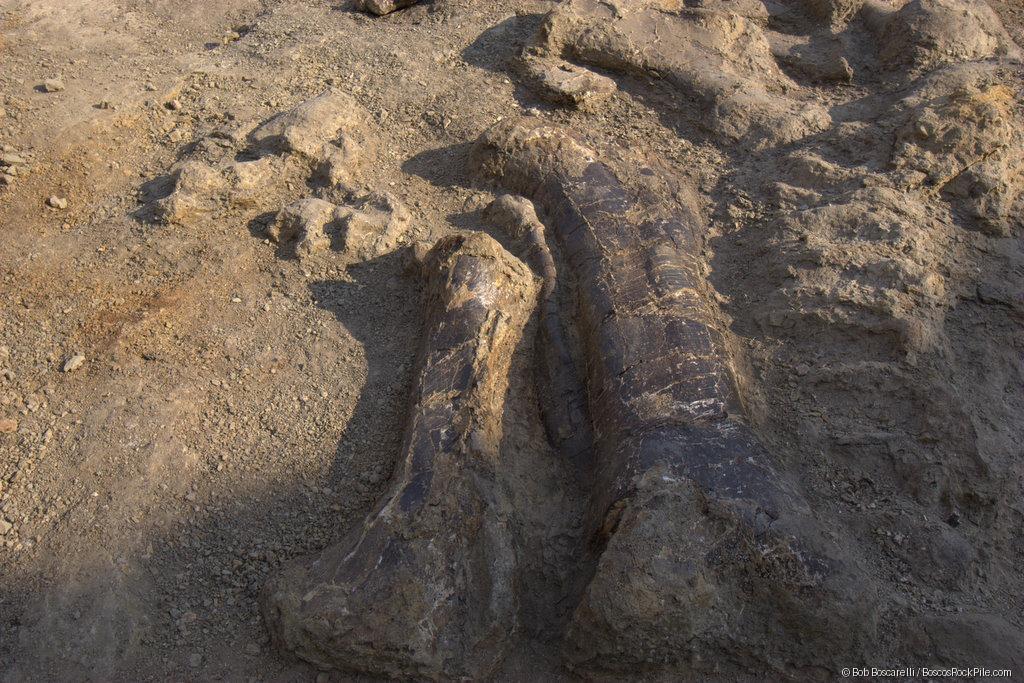
Large sauropod limb bones in articulation
Two large limb elements (femur/tibia or radius/ulna) in near-articulation. Deeply mineralized dark bone contrasts sharply with the sandy Morrison matrix. June 29, 2007.
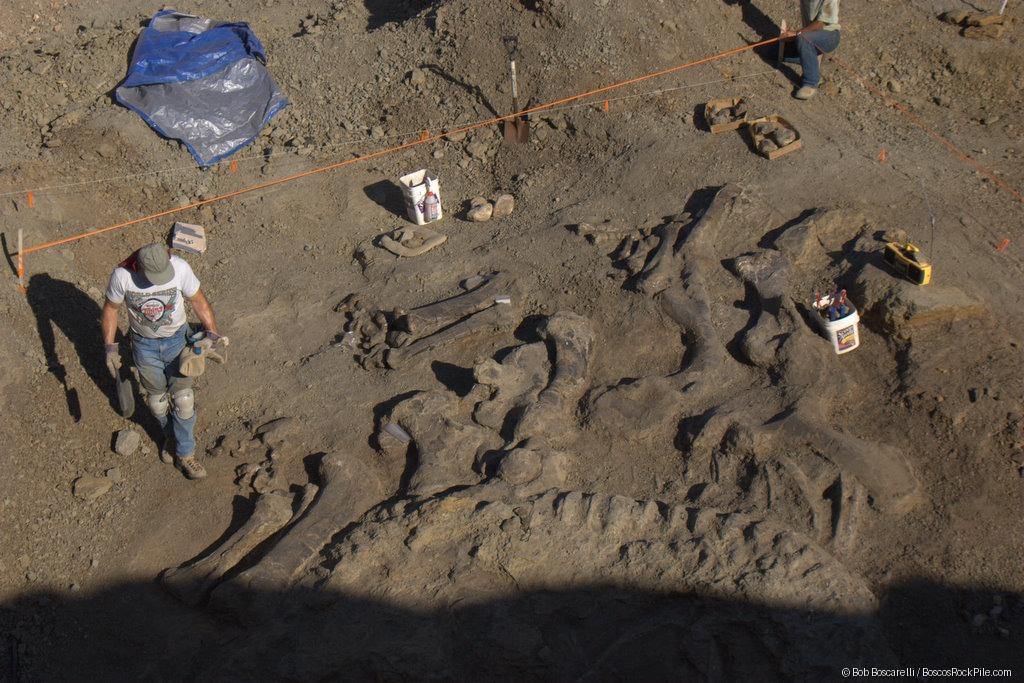
Advanced excavation — pelvis and associated elements
Late-season aerial view showing a large girdle/pelvis complex with associated ribs, vertebrae, and limb elements. One digger visible for scale. June 29, 2007.
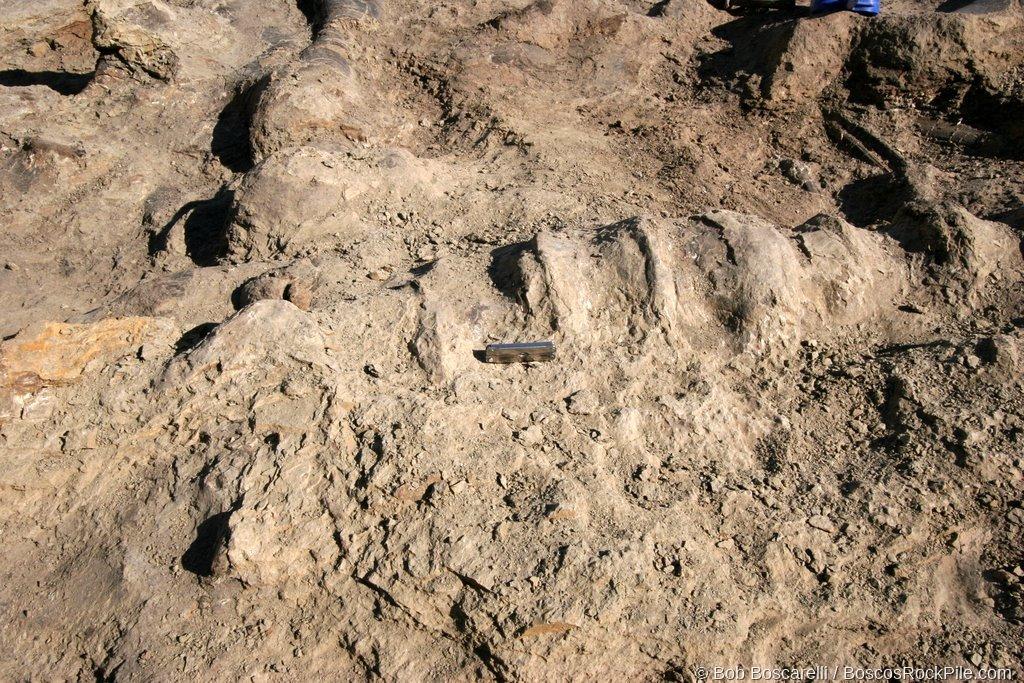
Sauropod bone elements in matrix with scale marker
Multiple rounded bone elements (vertebral centra or rounded epiphyses) in matrix with scale marker. Morrison Formation, Shell Wyoming. June 23, 2007.
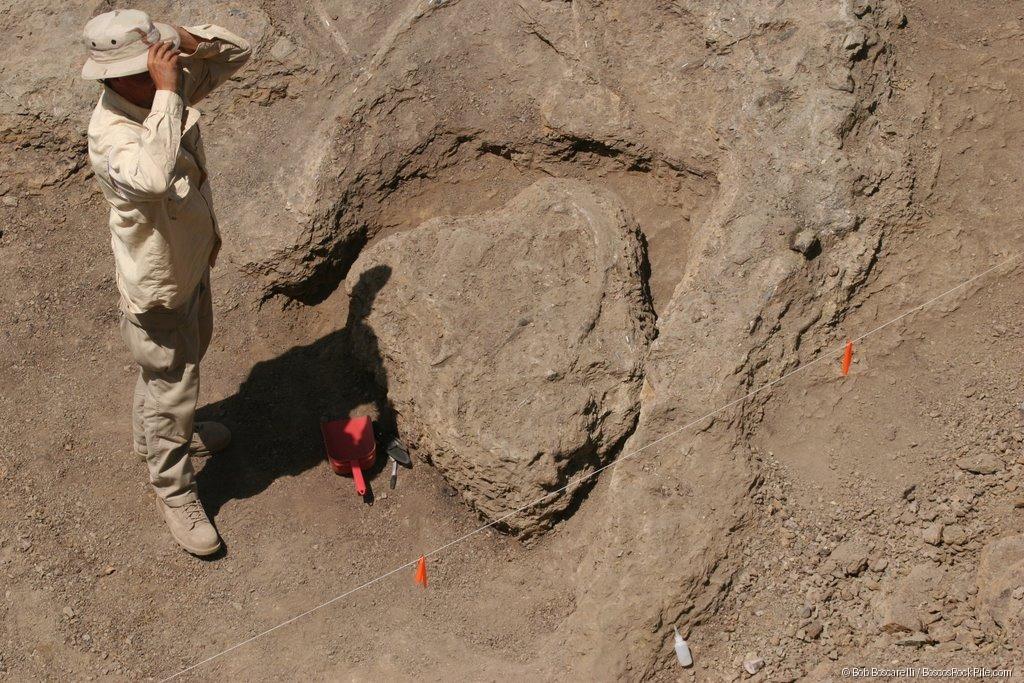
Discovery moment — person with large circular bone element
A digger stands next to the freshly exposed skull of the Camarasaurus — approximately 1 meter in diameter. Morrison Formation, Shell, Wyoming, June 29, 2007.

Field Documentation — Summer 2007

These photographs document the excavation team, methods, and progress across the 2007 field season. The dig involved a core crew of experienced fossil preparators working alongside visiting paleontologists, geologists, and members of the public on tour days. The Morrison Formation cliff faces visible in many images show the characteristic red, grey, and tan banding of floodplain and lacustrine sediments that have preserved these remarkable specimens for 150 million years.
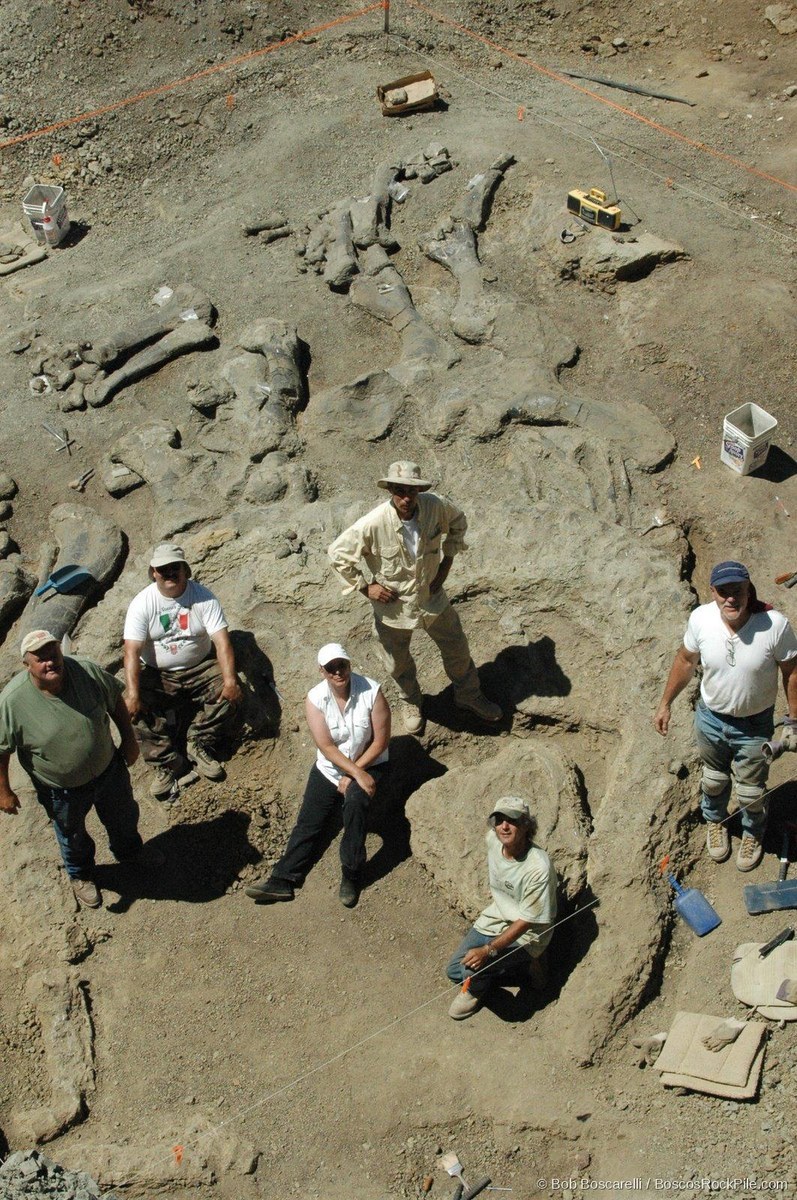
Dig crew team portrait in the quarry
The 2007 dig crew posed in the quarry, surrounded by exposed bone elements. Shell Wyoming Camarasaurus Dig.
Three crew members with exposed skeleton
Three crew members standing in the quarry with massive articulated skeleton elements across the foreground. The human figures provide dramatic scale.
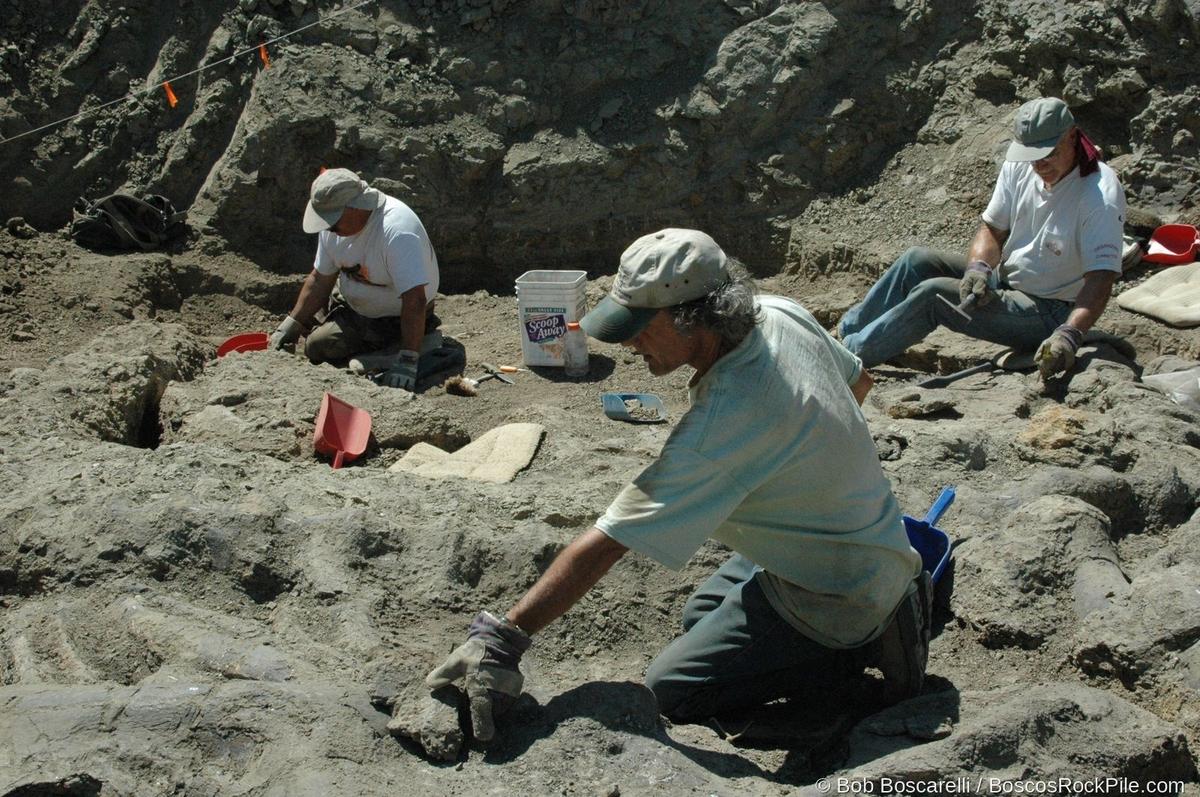
Three diggers actively excavating quarry face
Three crew members simultaneously excavating different sections of the quarry face. Shell Wyoming, 2007.
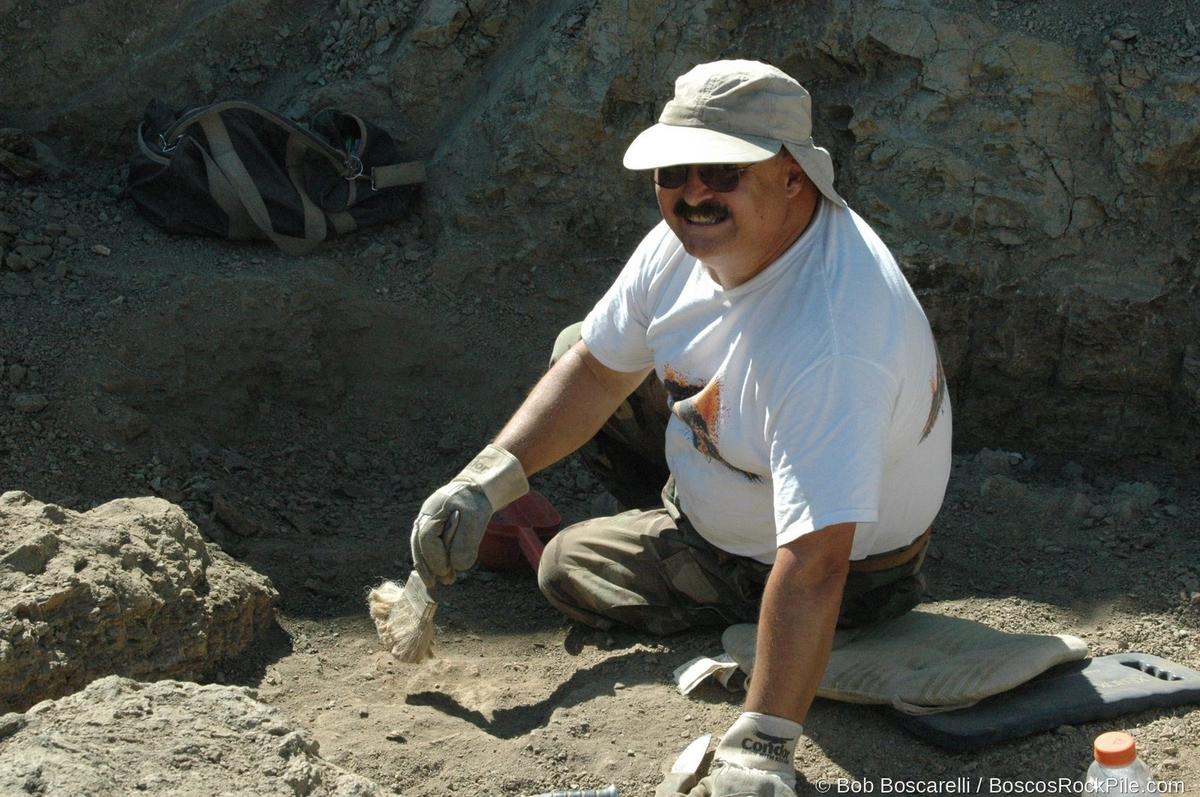
Bob Boscarelli excavating at quarry face
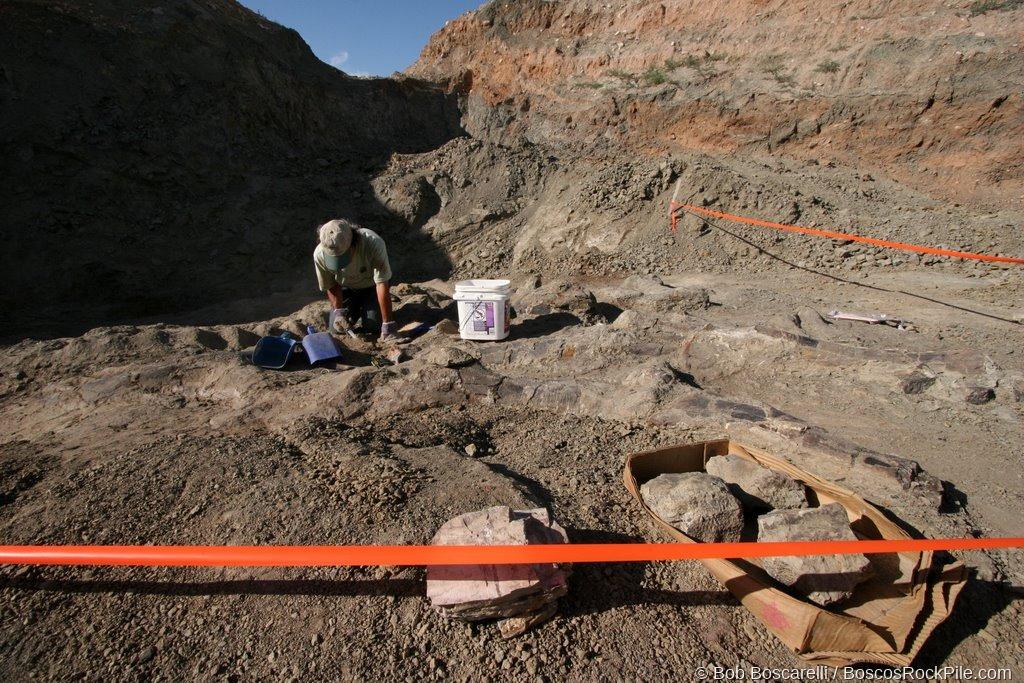
Bob Boscarelli working a bone element with a brush at the quarry face. Morrison Formation wall visible behind.
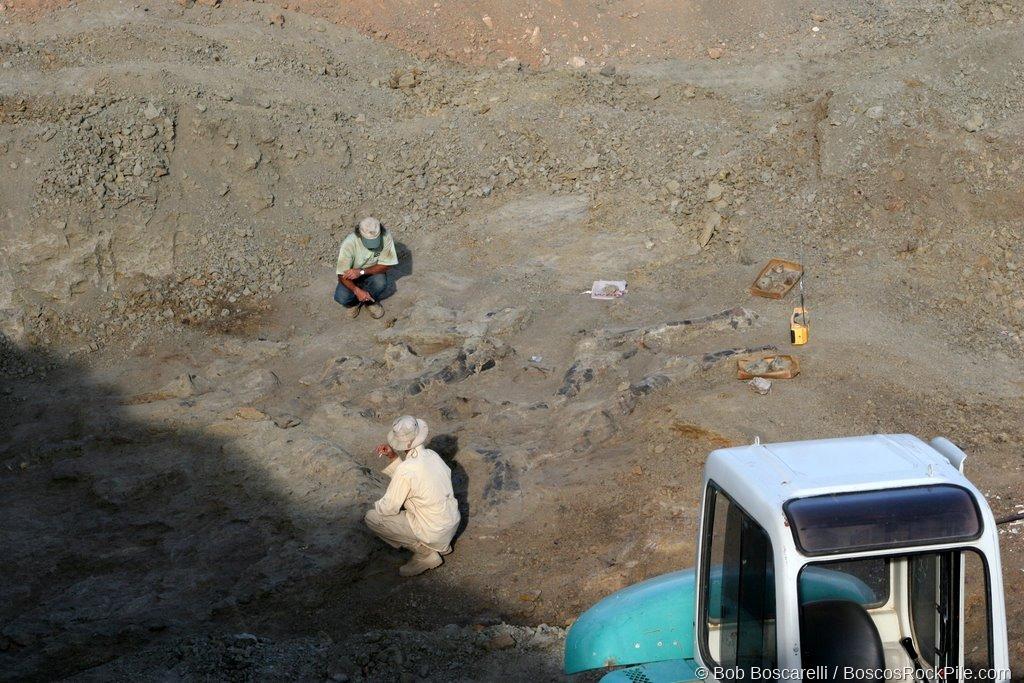
Early morning quarry — two diggers, bones exposed
Aerial view at start of the day: two diggers at work, dark bone elements visible on the floor. Strong morning light. June 23, 2007.
Excavation with Morrison Formation stratigraphy backdrop
Digger working at quarry floor level, Morrison Formation stratigraphy filling the background with red, grey, and tan bands. June 23, 2007.
Aerial view — three diggers, full skeleton
Aerial of full quarry floor with three diggers working around the exposed skeleton. Multiple bone elements visible. June 29, 2007.
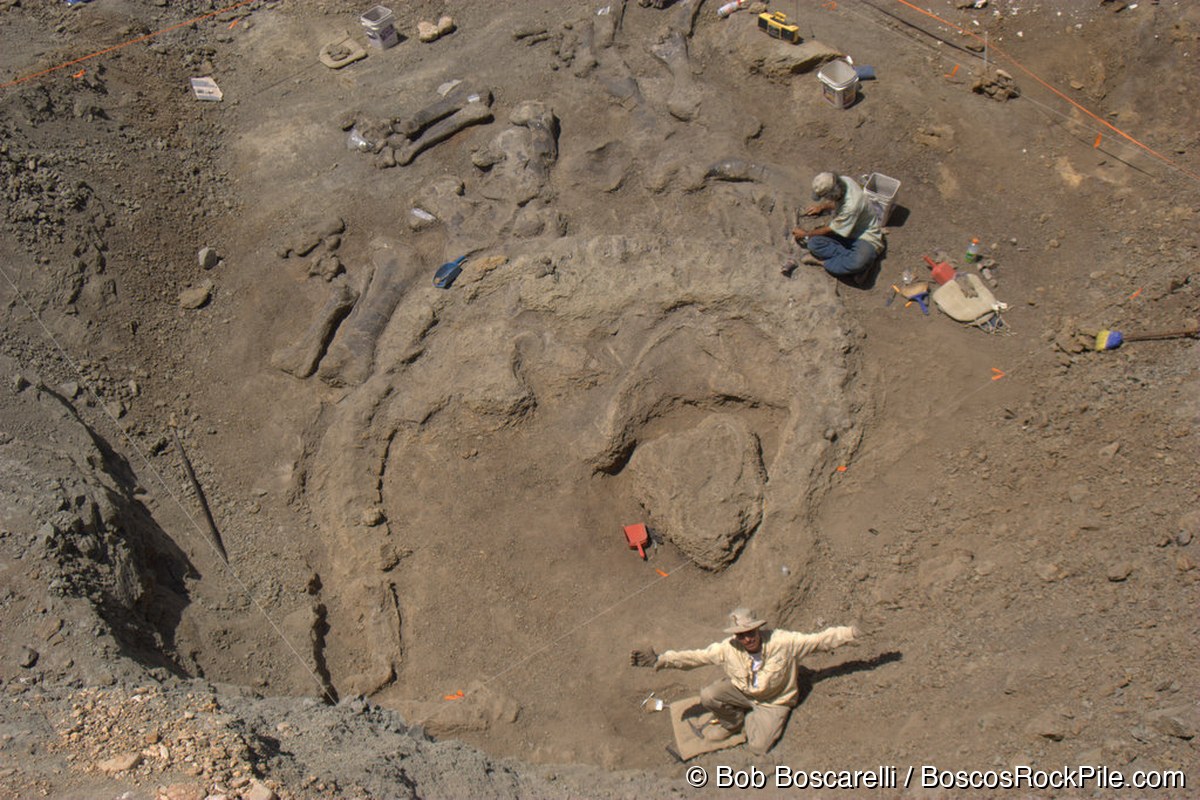
Camarasaurus quarry late-stage aerial view — plaster jacket and limb bones exposed, Shell Wyoming 2007
Late-stage aerial documentation of the Shell Wyoming quarry. A large plaster field jacket occupies the center — the circular pedestal from which the skull had been removed. Exposed limb elements visible at upper frame. Two diggers provide scale. Morrison Formation, Shell, Wyoming, June 29, 2007. © Bob Boscarelli / BoscosRockPile.com
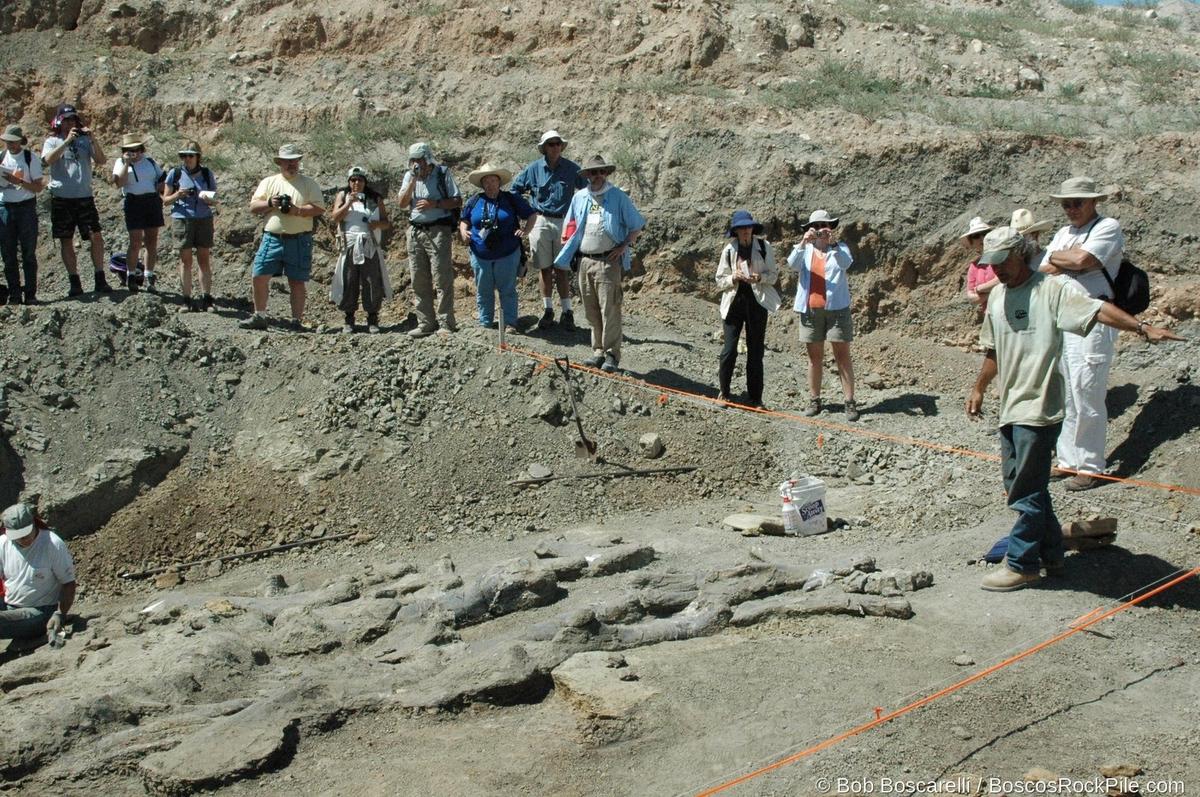
Public tour at quarry edge — large group
A large group of visitors observing the excavation. A long bone element is visible on the quarry floor below. Tour guide explaining the dig. Shell Wyoming 2007.
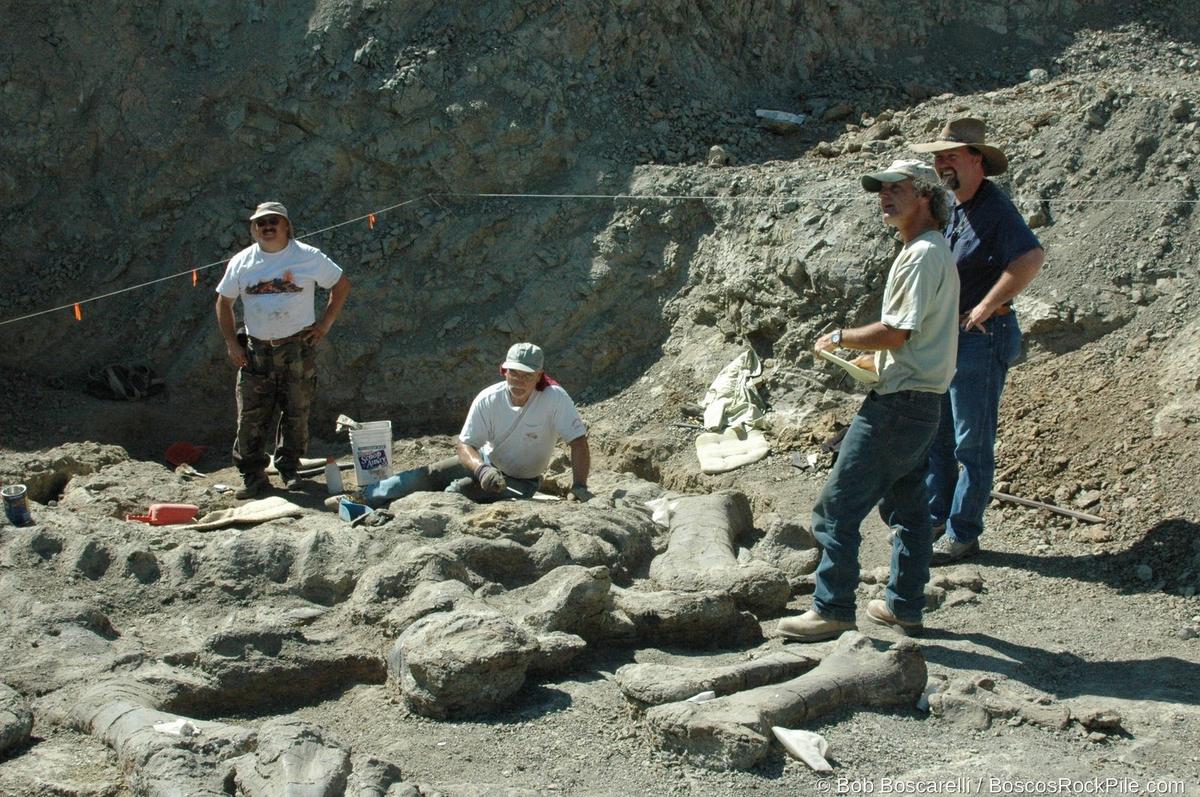
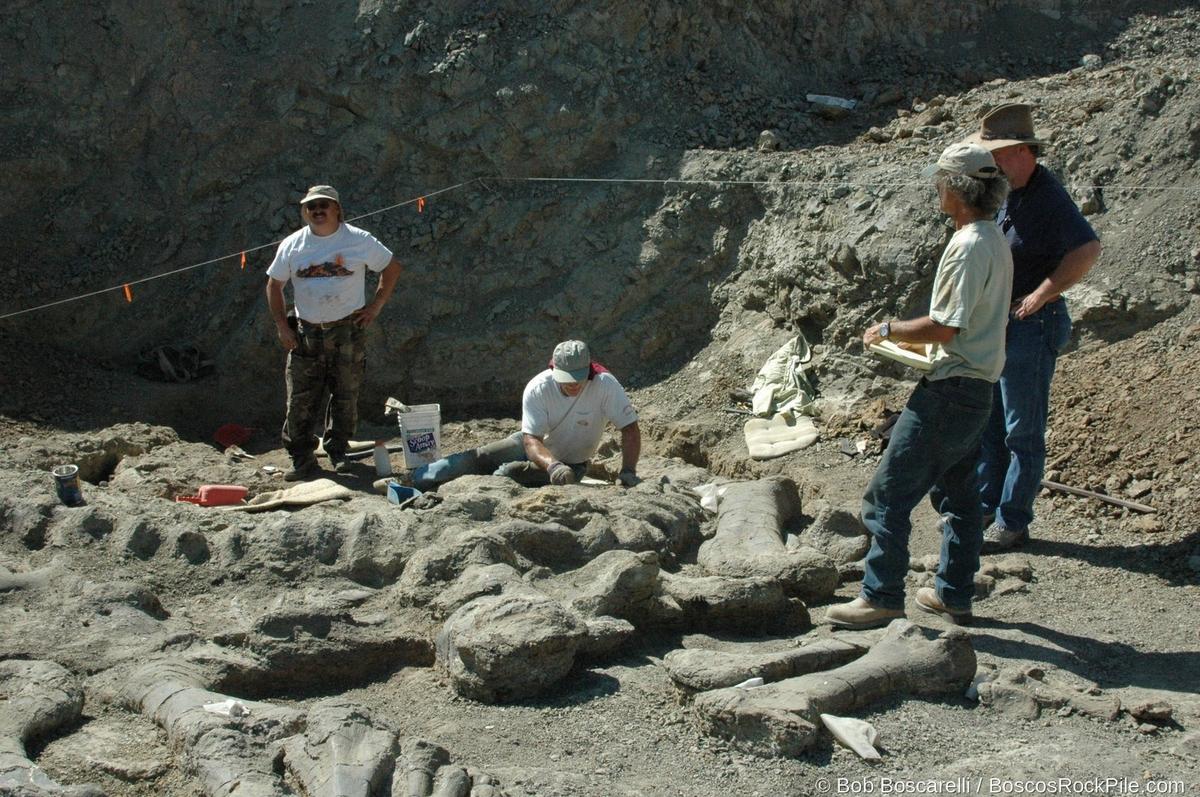
Dig crew discussing specimen — quarry floor
Three crew members in animated discussion over a bone element. Large limb bones and vertebrae visible throughout the frame. Shell Wyoming, 2007.
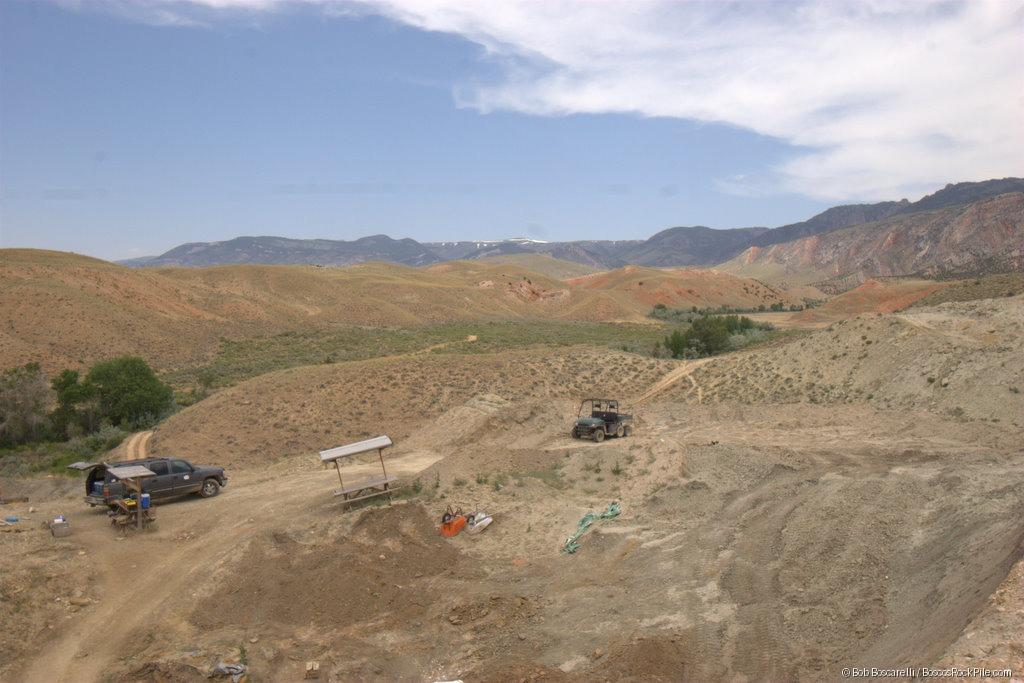
Shell Wyoming valley panorama with dig camp
Sweeping view of the Shell, Wyoming valley from the Morrison Formation exposure. Dig camp (canopy, vehicles, UTV) in the foreground. Snow-capped Bighorns on the horizon. June 29, 2007.
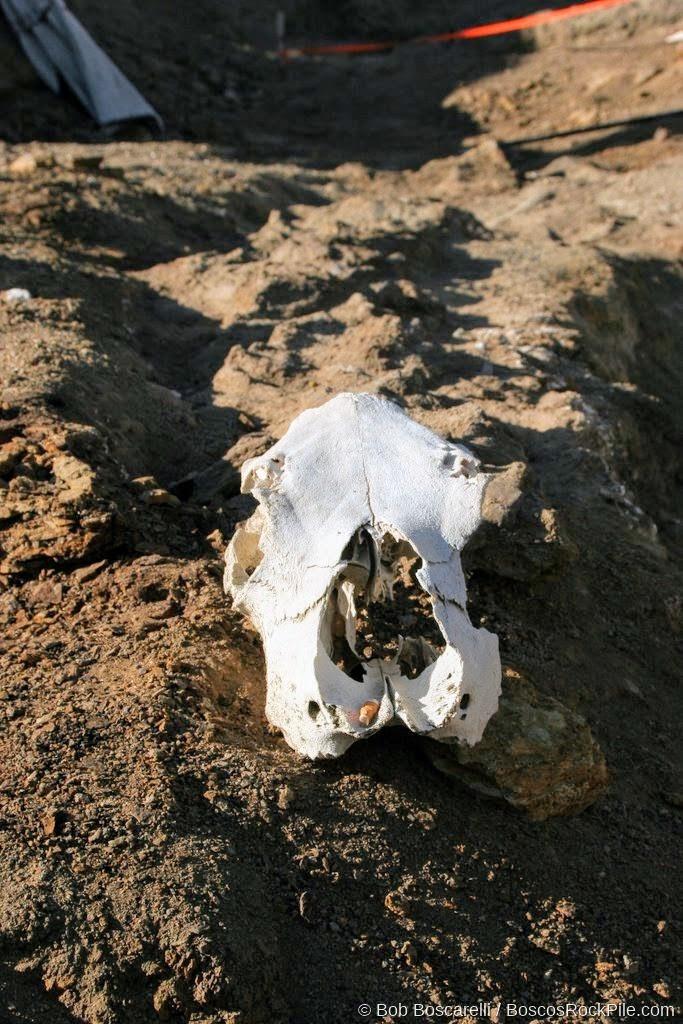
Mammal skull found at dig site
A bleached mammal skull found during excavation activities at the site. Modern/sub-recent find discovered during the 2007 season. June 23, 2007.

Scientific Context

The Morrison Formation is a sequence of Late Jurassic sedimentary rocks deposited approximately 155–145 million years ago across what is now the western United States. The formation represents a vast semi-arid floodplain environment — the ancient heart of North America — and contains one of the richest concentrations of dinosaur fossils ever discovered. Major taxa documented from the Morrison include Camarasaurus, Diplodocus, Brachiosaurus, Allosaurus, Stegosaurus, and dozens of other species.

Camarasaurus was the most abundant large sauropod of the Morrison Formation. Adults reached lengths of 15–23 meters and could weigh 20 tons or more. The genus is characterized by its short, blunt skull (unlike the elongated skull of Diplodocus), robust vertebrae with prominent neural spines, and proportionally longer forelimbs. The Shell, Wyoming site preserves exceptional articulated material suggesting death and burial events that kept skeletal elements in anatomical position through the fossilization process.

Diplodocus, also documented at this site, was one of the longest dinosaurs ever to walk the Earth — reaching up to 27 meters in length with its extraordinarily elongated neck and tail. The gracile ribs and long, low vertebrae visible in the aerial overview photograph are consistent with this genus.


Image Licensing & Research Inquiries

All photographs on this page are original field documentation images taken by Bob Boscarelli during the 2007 Shell Wyoming excavation season. The images displayed here are web-optimized versions. High-resolution archival files are available for:

Scientific publications — journal articles, monographs, conference proceedings
Museum and exhibition use — interpretive panels, educational displays
Documentary and media production — film, television, online educational content
Print and fine art — archival prints available for collectors
Textbook and educational publishing

Bob Boscarelli has maintained this paleontological archive for nearly two decades as a personal project, without institutional funding or outside support. Licensing fees help sustain the ongoing digitization, preservation, and documentation of this unique historical record.

For licensing inquiries, research access, or print orders, please use the contact form. Please include “Image Licensing” in your subject line and specify the intended use and resolution requirements.

Scroll to Top