
Soquel Seismograph Station
Live seismic and atmospheric monitoring from Bosco’s field station. Data is captured continuously and updated every 5 minutes.
Live Helicorder — Seismic Activity
The helicorder below displays real-time ground motion data recorded by the station seismograph. Each horizontal line represents 60 minutes of data; time runs left to right, top to bottom. Darker traces indicate stronger ground motion.
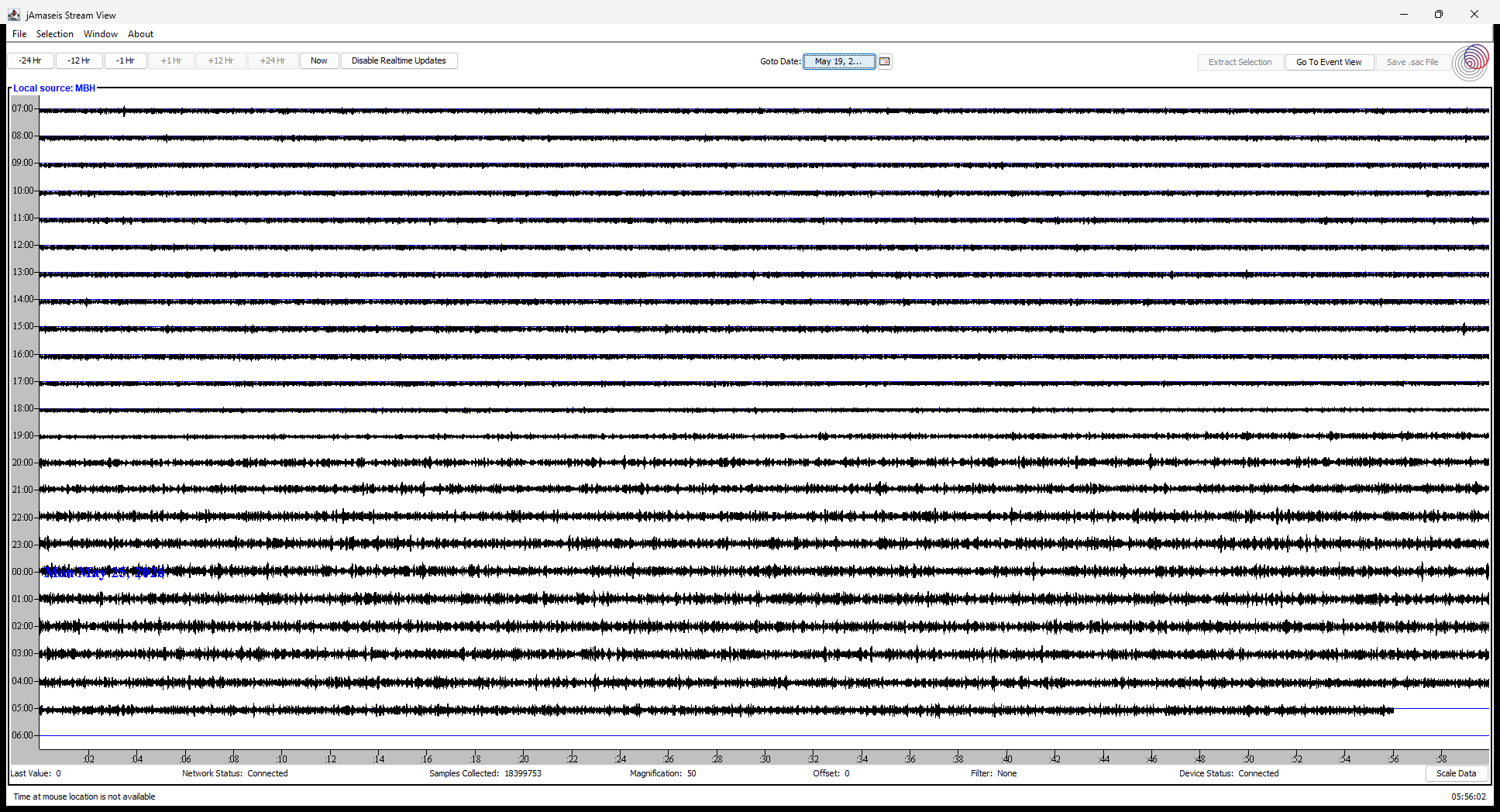
🟢 Live · Updates every 5 minutes · Checking…
Station Specifications
| Instrument | Seismograph (helicorder pipeline) |
| Data format | Helicorder image (PNG), 24-hour rolling window |
| Update interval | Every 5 minutes |
About the Station
The Earth Science Station is a personal monitoring setup designed to capture ambient seismic activity and atmospheric conditions. The seismograph runs continuously, generating a helicorder image that refreshes on this page every five minutes.
The live helicorder above auto-refreshes every 5 minutes, client-side — no page reload required.
A bit of history
This station has a backstory that predates the equipment above. When the magnitude-6.9 Loma Prieta earthquake struck on October 17, 1989 — its epicenter in the Santa Cruz Mountains, not far from Soquel — Bosco did not yet own a seismograph. The quake was caught locally by David Reynolds, Bosco’s father-in-law, on a seismograph he had built by hand. The instrument and the recording tape are his, not Bosco’s.
Bosco set up his own station — an EQ-1 seismograph — in Soquel, California, in 2002. The live helicorder at the top of this page continues that work today, watching the same restless ground that Reynolds’s homemade machine recorded back in 1989.