Mohs Hardness Scale
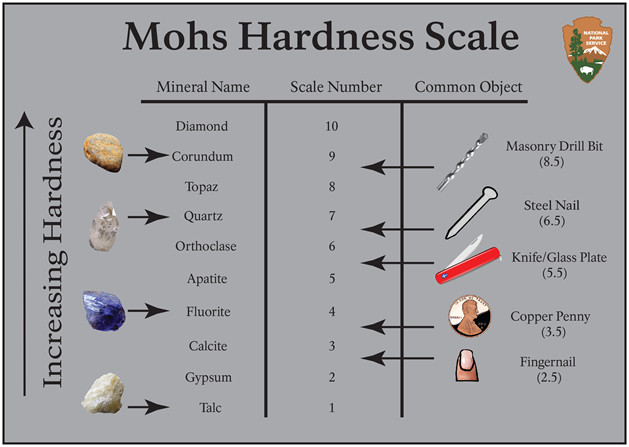
The Mohs Hardness Scale, devised by German geologist Friedrich Mohs in 1812, is one of the simplest and most useful tools for identifying a mineral. Hardness is a mineral’s resistance to being scratched — and because each mineral has a fairly consistent hardness, a quick scratch test can go a long way toward telling you what you’re holding.
How the scratch test works
The rule is simple: a harder mineral will scratch a softer one, but never the reverse. To test an unknown specimen, try to scratch it with an object (or reference mineral) of known hardness. If your test point leaves a scratch, the specimen is softer; if it only leaves a streak that wipes away, the two are about equal.
One caveat worth remembering: the scale is relative, not linear. The steps aren’t evenly spaced — diamond (10) is several times harder than corundum (9), even though they sit just one step apart.
The ten reference minerals
| Hardness | Mineral | Notes |
|---|---|---|
| 1 | Talc | Softest — crushes to powder (talcum) |
| 2 | Gypsum | Scratched by a fingernail |
| 3 | Calcite | Scratched by a copper coin |
| 4 | Fluorite | Easily scratched by a knife |
| 5 | Apatite | Just scratched by a knife |
| 6 | Orthoclase (feldspar) | Scratches glass; a steel file scratches it |
| 7 | Quartz | Scratches glass and steel readily |
| 8 | Topaz | Harder than quartz |
| 9 | Corundum | Ruby and sapphire |
| 10 | Diamond | Hardest known natural material |
Handy field tests
You don’t need a full kit of reference minerals to get close — common objects work well in the field:
- Fingernail — about 2.5
- Copper coin — about 3
- Steel pocketknife or nail — about 5.5
- Window glass — about 5.5
- Steel file — about 6.5
So if a specimen scratches glass but a steel file scratches it back, you’re looking at something around 6 — feldspar territory. If it scratches the file too, you’re at quartz (7) or higher.