Dinosaur Extinction
Sixty-six million years ago the Cretaceous ended and roughly three-quarters of the species on Earth went with it. The non-avian dinosaurs, the pterosaurs, the marine mosasaurs and plesiosaurs, the ammonites, and most of the plankton that built the ocean food web vanished at the same geological instant. Birds, mammals, crocodilians, turtles, and amphibians came through. That line in the rock is the Cretaceous–Paleogene boundary — the K–Pg boundary, still called K–T in older books — and what caused it is one of the great arguments in geology.
This page is the successor to the extinction-theories list that lived on this site from the late 1990s. Most of those links are gone now; the argument they pointed at has largely been settled, and where it has not, the open questions are sharper than they were. Here is where it stands.
The dinosaurs on this site missed it by 85 million years
A quick note of scale first. The Camarasaurus and the Stegosaurus excavated at Shell, and the animals at Como Bluff, come from the Morrison Formation — Late Jurassic, about 150 million years old. They were long gone before the extinction. Between the Morrison and the K–Pg boundary lies the entire Cretaceous: more time than separates the last Tyrannosaurus from us.
The asteroid
In 1980 the physicist Luis Alvarez, his son the geologist Walter Alvarez, and the chemists Frank Asaro and Helen Michel reported something odd in a thin clay layer at the boundary near Gubbio, Italy, and again at Stevns Klint in Denmark: a spike of iridium, an element rare in Earth’s crust but common in meteorites. They proposed that an asteroid roughly 10 km across had struck the Earth, and that the debris and darkness that followed collapsed photosynthesis worldwide.
The idea was ridiculed and then confirmed, piece by piece:
- The iridium anomaly turned up in boundary clays around the world.
- Shocked quartz — grains with deformation lamellae that form only under impact pressures — was found in the same layer, most abundantly in North America.
- Spherules of impact glass and tektites concentrated toward the Caribbean, along with soot and disturbed, tsunami-like deposits along the Gulf coast.
- In 1991 the crater itself was identified: Chicxulub, about 180 km across, buried under the northern Yucatán Peninsula, first seen in oil-company gravity surveys in the 1970s. In 2016 a joint IODP–ICDP expedition drilled its peak ring and brought up the shattered, once-molten granite of the impact.
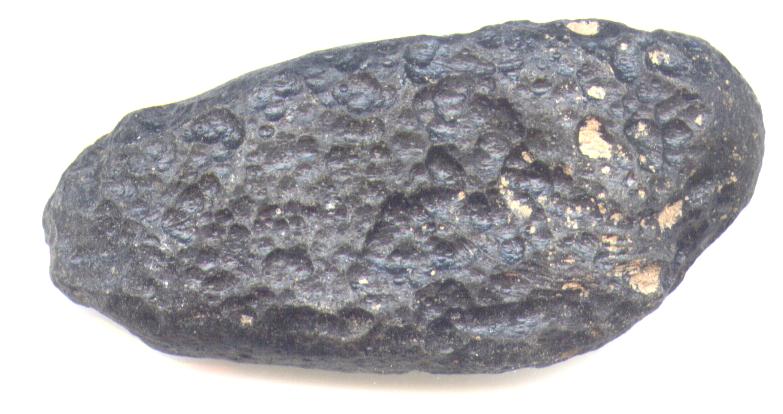 A tektite from the collection — impact glass, the kind of debris that rained down after Chicxulub. The meteorite specimen is on the Rocks and Minerals page.
In 2010 a panel of forty-one scientists reviewed twenty years of evidence in Science and concluded that the Chicxulub impact was the cause of the end-Cretaceous extinction. That is the mainstream position today.
The volcanoes
The strongest rival was never a fringe idea. The Deccan Traps of western India are one of the largest volcanic provinces on Earth — more than a million cubic kilometres of basalt, erupted in pulses across the boundary. Dewey McLean at Virginia Tech argued from the 1970s on that Deccan carbon dioxide and a runaway greenhouse did the killing; French geophysicist Vincent Courtillot carried the case for decades. Their reasoning had weight: the other great mass extinctions line up with giant eruptions, not impacts.
The sharpest recent work has been on timing. Two teams published high-precision dates in Science in 2019 and disagreed on the detail: one placed the largest Deccan pulse in the 100,000 years after the impact, the other had eruptions running steadily through the boundary. A 2020 study of ocean temperature records found that the Deccan warming came before the extinction and had faded by the time the impact hit — leaving the asteroid as the killing blow, with the volcanoes as background stress. That “press-pulse” picture — a long press of volcanic climate change and falling sea levels, then the pulse of the impact — is where many workers have settled.
The theories that did not make it
Before iridium, the field was wide open, and the list of proposals ran past a hundred. Some of the serious ones: slow climate cooling; sea-level fall draining the shallow inland seas; disease; competition from mammals eating dinosaur eggs; eggshell thinning; a nearby supernova. And the less serious: the animals grew too big, or were poisoned or constipated by the newly evolved flowering plants. The University of Bristol’s palaeontologists kept a famous catalogue of them.
Most fail the same test: they cannot explain why the extinction was global, simultaneous, and selective — why plankton in the open ocean and dinosaurs on land died in the same thin layer while turtles and crocodiles did not. An impact winter, a few years of darkness and cold on top of a stressed world, does.
What is still open
- Were dinosaurs already in decline? Some analyses of the fossil record say species numbers were falling through the last ten million years of the Cretaceous; others find the record too patchy to say. The Hell Creek Formation of Montana and the Dakotas is the main battleground.
- Tanis. A site in North Dakota described in 2019 preserves fish with impact spherules in their gills and a surge deposit that its discoverers read as the first hours after the strike. It is spectacular and still being argued over.
- How much did Deccan matter? The dates are now good enough that the argument is about hundreds of thousands of years, not millions. That is progress.
The other four
The end-Cretaceous is the most famous mass extinction but not the largest. Geologists count five:
| When | Event | What happened |
|---|---|---|
| ~444 Ma | End-Ordovician | Glaciation and sea-level fall; ~85% of marine species |
| ~372 Ma | Late Devonian | Prolonged crisis, reefs collapsed; cause debated |
| ~252 Ma | End-Permian, “the Great Dying” | Siberian Traps volcanism; ~90% of marine species, the worst on record |
| ~201 Ma | End-Triassic | Central Atlantic volcanism as Pangaea split; cleared the way for the dinosaurs’ dominance |
| 66 Ma | End-Cretaceous | Chicxulub impact, Deccan Traps in the background; the dinosaurs |
Four of the five coincide with giant volcanic provinces. Only one has a crater. That is why the Deccan question was never foolish, and why the answer at the K–Pg boundary — an impact — is the exception rather than the rule.
An impact you can stand on
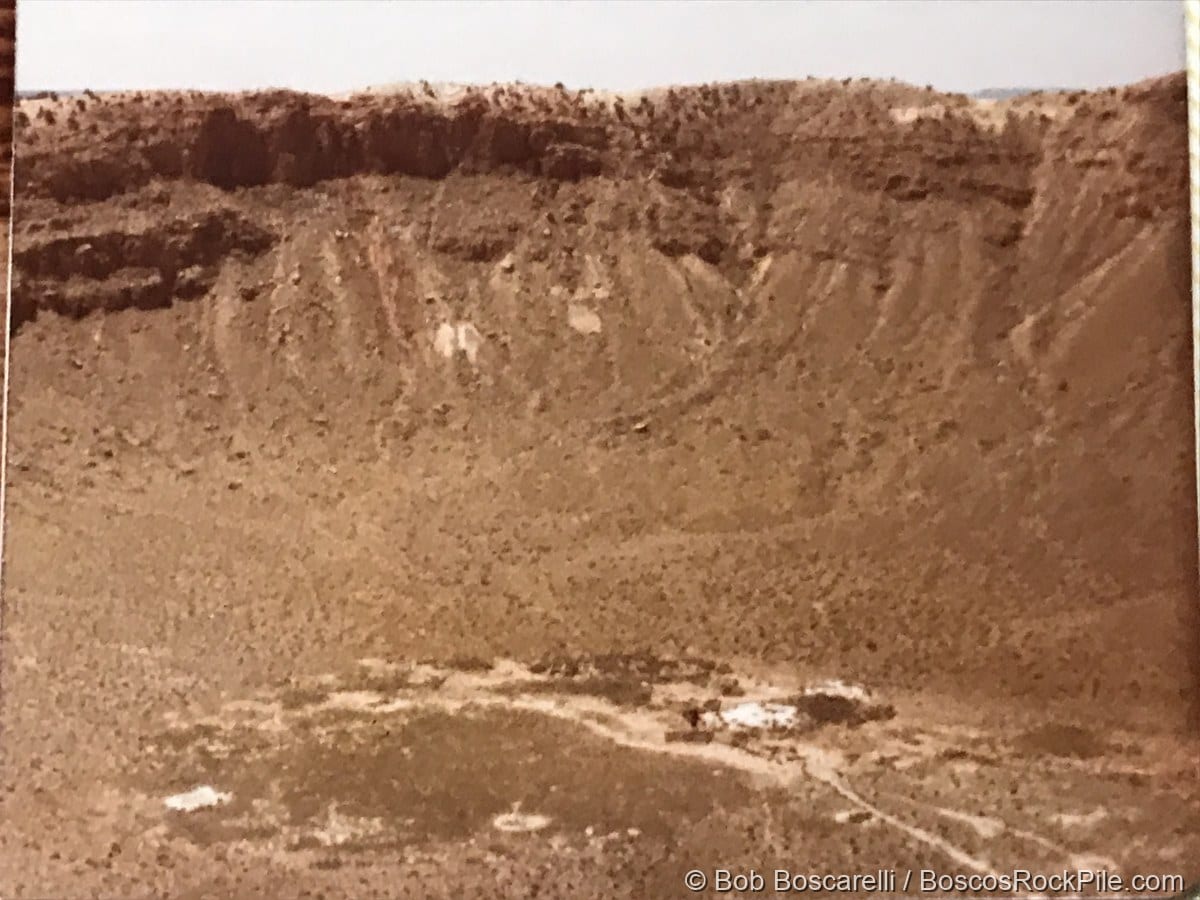
The photograph at the top is Meteor Crater in Arizona. The University of Florida field camp stopped there in the summer of 1979, and the notebook entry — “bowl shape; 600′ deep, ¾ mi diameter… debris: unsorted angular blocks” — is in the 1979 Field Journal. It is 50,000 years old and about 1.2 km across, dug by an iron meteorite perhaps 50 metres wide. Chicxulub’s crater is 150 times the diameter. Standing on that rim is the best way there is to feel what the numbers mean.
Reading and sources
- UCMP Berkeley — The Great Mystery: what killed the dinosaurs? — the clearest general account, and one of the few links from the old list still standing.
- Natural History Museum, London — How an asteroid ended the age of the dinosaurs
- Alvarez, Alvarez, Asaro & Michel (1980), “Extraterrestrial cause for the Cretaceous–Tertiary extinction,” Science 208 — doi:10.1126/science.208.4448.1095
- Schulte et al. (2010), “The Chicxulub asteroid impact and mass extinction at the Cretaceous–Paleogene boundary,” Science 327 — doi:10.1126/science.1177265
- Schoene et al. (2019) and Sprain et al. (2019), the two Deccan timing papers, Science 363 — doi:10.1126/science.aau2422 · doi:10.1126/science.aav1446
- Hull et al. (2020), “On impact and volcanism across the Cretaceous–Paleogene boundary,” Science 367 — doi:10.1126/science.aay5055
- Fin des dinosaures — Frédéric Malmartel’s French site on the end of the dinosaurs, which has linked to this page since the old days.