
Dinosaur Rock
There was a page here called Dinosaur Rock from about 1994 until the site was rebuilt. It said, more or less, “see some Dinosaur Rock (old time) music performed by Bosco,” and it pointed at a single acoustic cover — All Along the Watchtower, which is still online and linked below. This is that page again, with the part the original left out: the playing was not a hobby that happened near the fossils. It came first, and it was documented at the time by other people.
Gainesville, 1976–77
The University of Florida years were the working ones. The evidence is other people’s printing, not recollection.
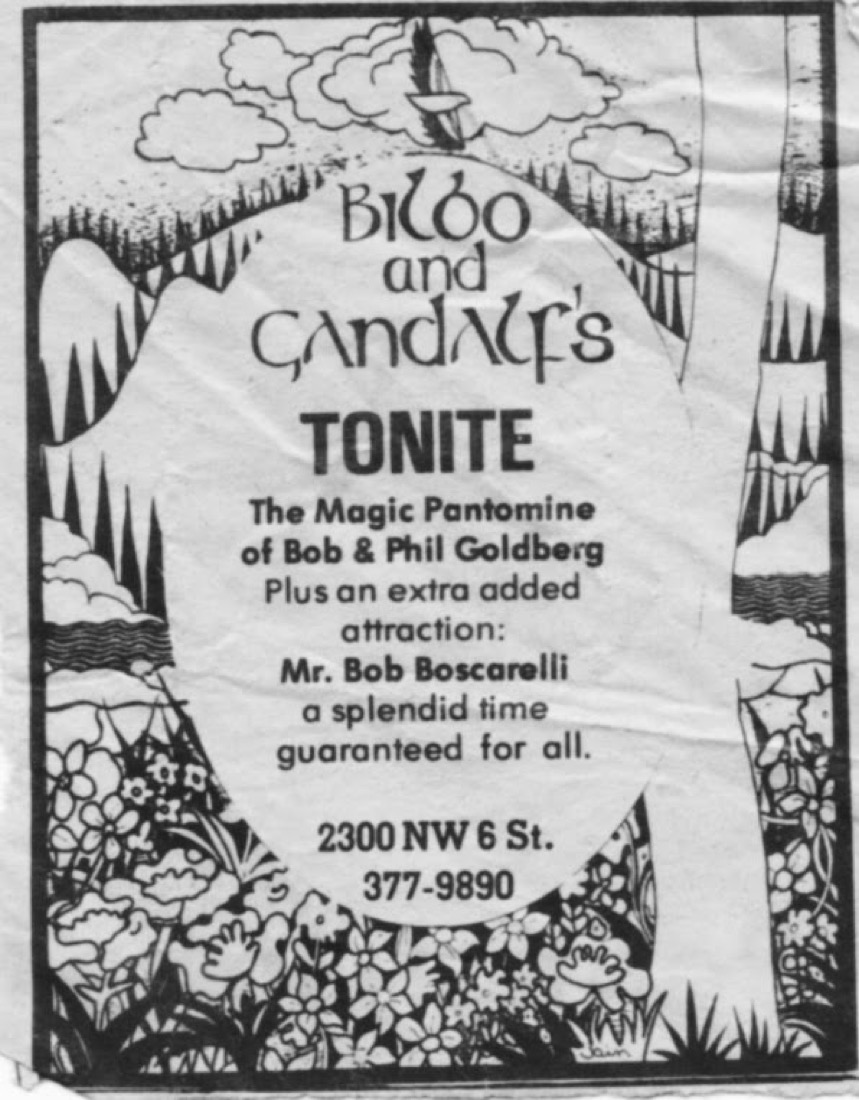 A handbill for Bilbo and Gandalf’s, 2300 NW 6th Street, Gainesville. The billing reads: “TONITE — The Magic Pantomine of Bob & Phil Goldberg. Plus an extra added attraction: Mr. Bob Boscarelli. A splendid time guaranteed for all.” The closing line is borrowed from “Being for the Benefit of Mr. Kite!” The handbill carries no date.
He turns up in the Mad Monk’s Inn entertainment listings for November 23–25, 1976, in the same columns as Frank Plazo, Red Henry and Tampa Fred — the working Gainesville folk and bluegrass scene of those years.
The Freedom Train
 Schedule of Trackside Entertainment, issued by the Alachua County Arts Council for the American Freedom Train’s Gainesville stop, November 29 – December 1, 1976. Bosco is listed three times.
The American Freedom Train — the bicentennial exhibition train that toured the country — made its 132nd stop at Gainesville over three days in late 1976, and drew more than 30,000 people. He played the trackside stage, and the programme lists him by name three times.
On the same Wednesday bill, at five o’clock: Will McLean, described in the programme as “Florida’s own song writer and performer of folk music.” McLean (1919–1990) is remembered as the Father of Florida Folk.
Two weeks later the president of the Gainesville Area Chamber of Commerce, Joe G. Dunlap, wrote to thank him:
Over 30,000 folks, young & old, observed the American Freedom Train on its 132nd stop, here in Gainesville… A wonderful success and experience for the entire community. Your assistance in performing the task of “making it happen” with the Freedom Train is extremely appreciated and recognized by the Chamber’s Board of Directors… my personal thanks for a job well done!
The letter is addressed to Robert “Bosco” Boscarelli — which settles something small and nice: the nickname was not applied later. An institution was using it in writing in 1976.
Opening for Elvin Bishop
On 22 January 1977 he opened for Elvin Bishop at the University of Florida. The date comes from the signed contract — an Other Personal Service Contract with Student Services, Inc., entered into on 13 January 1977 — not from memory. Earlier versions of this story said 1974; the paperwork corrected it.
Nashville, 1976
In October 1976 he had a letter from NAR — Nashville Artist & Repertoire, Inc., dated 29 October and signed by Colin Walker, son of Bill Walker, the music director of the Johnny Cash Show. Two of the recordings that survive on tape, Seasons and Virginia’s in Kentucky, come from that Nashville period.
The White House, July 4, 1996
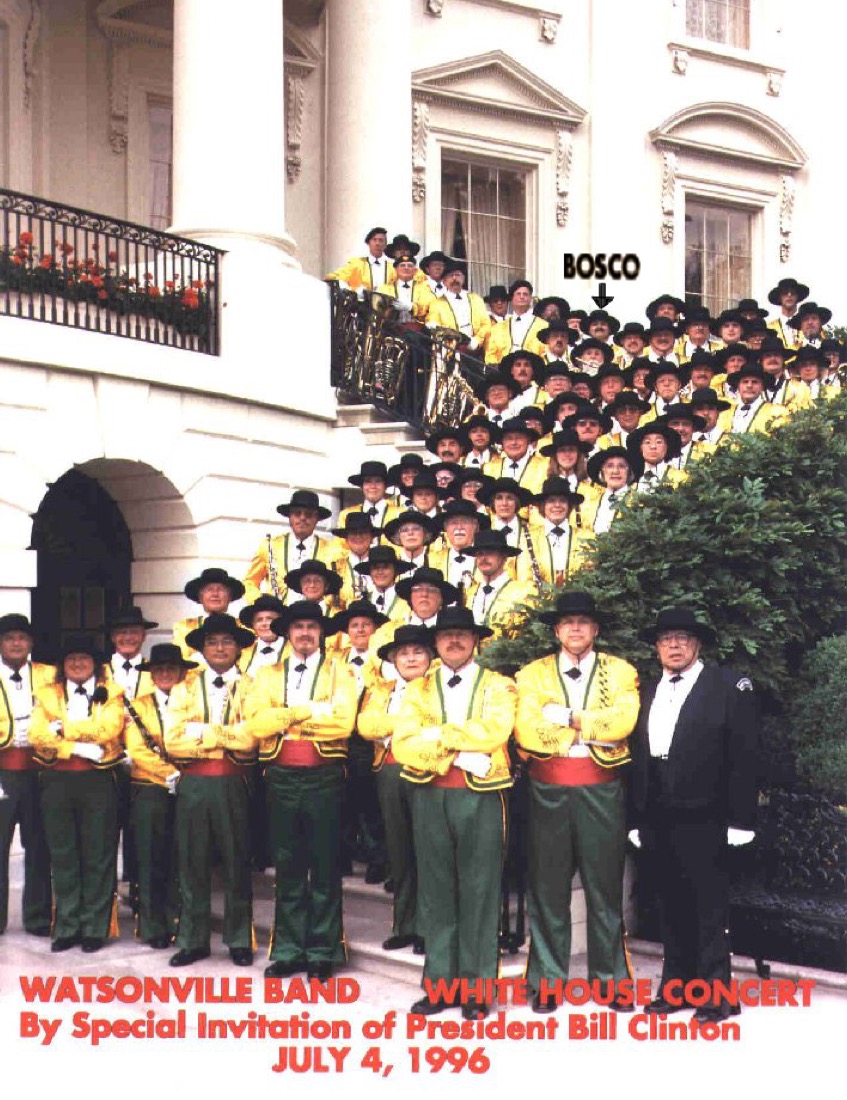 The Watsonville Band on the White House steps, Independence Day 1996. The arrow in the back rows marks Bosco — he labelled the print himself.
Twenty years after Gainesville, he was playing with the Watsonville Band when it was invited to perform at the White House on the Fourth of July, 1996 — the South Lawn, and the Independence Day parade in Washington. President Clinton greeted the band.
The invitation came through Ed Pio, who had joined the band as a Watsonville High junior in 1948 and been its manager since 1964. Pio had been Leon Panetta’s first campaign manager; he made the approach at a fund-raiser in Aptos, and it carried a community band from the Pajaro Valley to the South Lawn.
The Watchman was written in Zion
In the summer of 1979 the University of Florida field school spent nearly three weeks at Zion National Park, camped at Watchman Campground from July 4 to July 22, running mapping exercises with aerial photos and plane-table and alidade. The Watchman is the peak that stands over the campground and the south entrance of the canyon.
He wrote “The Watchman” there — words and music — in camp, on a geology field course. Thirty-one years later it became the first of his songs registered with the Copyright Office. The version on Apple Music is the instrumental; the acoustic version with the words sung has never been released, so the lyric written at Zion in 1979 is still unpublished. The rest of that summer, including the notebook pages, is on the 1979 Field Journal page.
It is the cleanest illustration of what this site is about: the songs and the rocks were never separate activities.
Listen
The album is Desert Dessert. Apple lists the tracks individually, under Bosco Boscarelli:
- The Watchman (Instrumental) (2010) — written at Zion, 1979. Instrumental only; the sung version is unreleased
- Lady Lady (2010) — original
- Seasons — from the Nashville period, released 2017
- All Along the Watchtower (2010) — the acoustic cover the old Dinosaur Rock page pointed at, still there
- Hey There Delilah (2011) — cover
The songs
Five works are registered with the United States Copyright Office and with ASCAP:
| Song | Registration | Filed |
|---|---|---|
| The Watchman (written at Zion, 1979) | SRu000952838 | 31 March 2010 |
| Lady, Lady | SRu000968428 | 8 June 2010 |
| Ride on the Wind | SRu000968716 | 8 June 2010 |
| Oh I Love You | SRu001001813 | 10 January 2011 |
| Interlude | SRu001001710 | 12 January 2011 |
Each was filed as “Sound Recording and Music,” which covers both the recording and the underlying composition — the stronger of the two ways to register.
Beyond the registered five, and the five you can play above, there are roughly fifteen finished originals on tape and on disk, most of them never released: So Long, Peaceful in the Country, Thru the Vortex, Crystal Lake, Sunshine Walking, Season’s Music, New Destination, Guitar Smilin’, Mellow Jam, and a thirty-five-minute session recording. The instrumentals are acoustic and unhurried, which is the kind of thing that ends up under nature documentaries.
Why “Dinosaur Rock”
Because it was old-time music, played by someone who spends his summers digging up things that are older still. The joke has held up for thirty years and there is no reason to retire it now.